Read the Names
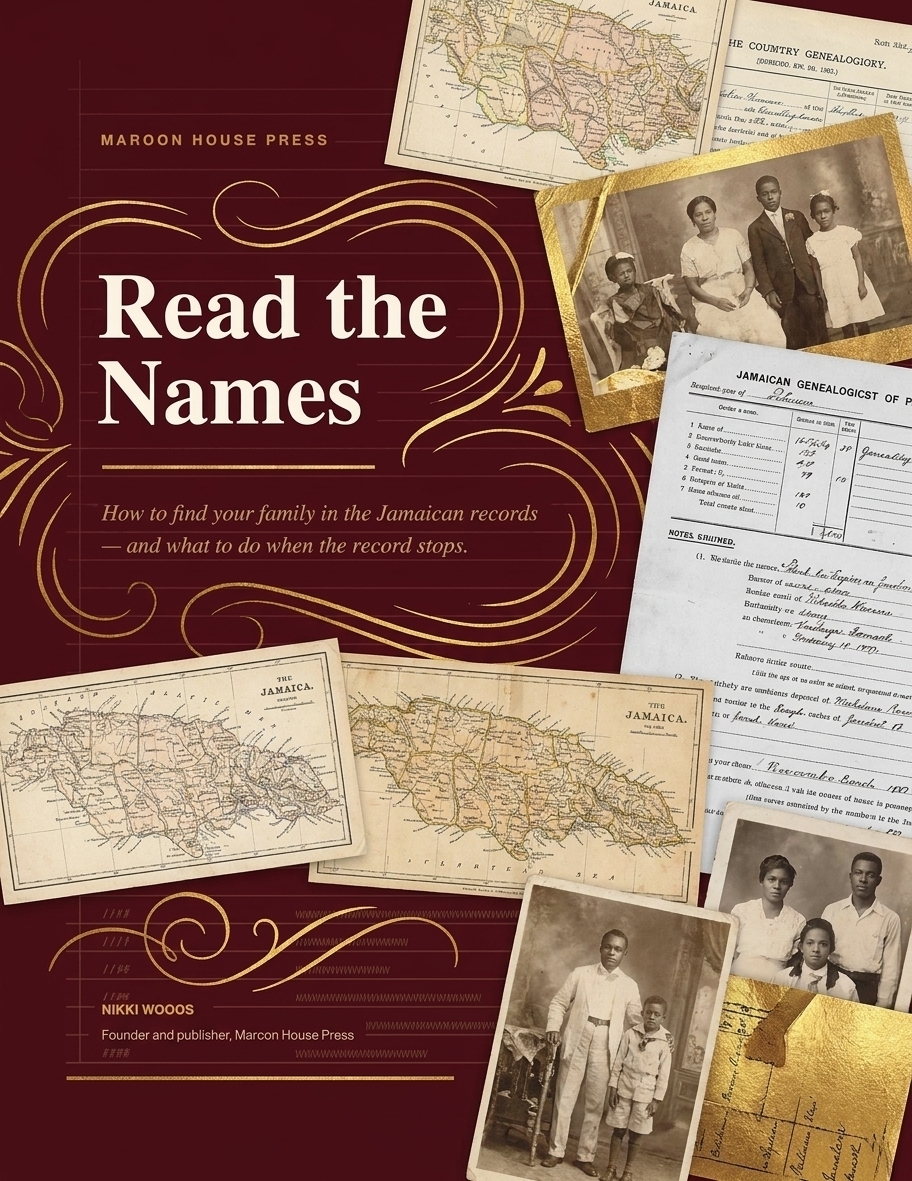
Start finding your
Jamaican family.
Begin with a name, a place, or a family story.
Get Read the Names, a free twelve-page guide to finding and understanding Jamaican family-history records — written from my own search in Portland Parish.
Free · Sent to your inbox · Unsubscribe anytime
You’ll also receive practical family-history notes and occasional updates on Heritage books and services.
Where should I send it?
Twelve pages, free. It arrives in your inbox in the next few minutes.
You already know one name. Go get the rest.
Twelve pages, five sets of records, and the order to open them in. Free.
Slave return · Jamaica · 1817–1834
| Name | Age | Colour | Country | Surname |
|---|---|---|---|---|
| Nancy | 41 | Negro | Creole | no entry |
| Quashie | 27 | Negro | African | no entry |
| Phibbah | 19 | Sambo | Creole | no entry |
| Cuffee | 8 | Negro | Creole | no entry |
The format of the returns filed by every estate on the island. Given name, age, and value. The column that would carry a family forward was never filled in.
Four people. One name between them — and it belonged to the man who owned them.
What is inside
Five doors, in the order to open them
FirstCivil registration
Where every Jamaican search should start, what the certificates actually hold, and how to order one without paying for the wrong record twice.
SecondChurch registers
Baptisms and burials reach back further than the state does. How to work out which parish register your family was entered in, and where those books sit now.
ThirdThe 1834 compensation records
The money Britain paid slave owners, listed by name and estate. Three traps before you trust a result — including the one that makes people think they have found their own surname.
FourthThe slave registers, 1817–1834
The returns above. What can still be recovered from a record built to count property, and how to read age, birthplace, and estate as evidence when the surname is missing.
FifthLand, wills, and the ground itself
What to do when the paper runs out. Deeds, probate, district names, and the family still standing on the land who remember who is buried where.
I did not write this from a distance. I wrote it going through my own line.
Every door is worked through with my grandmother's family — the Grays of Swift River, Portland Parish — including the places I got stuck, the searches that returned nothing, and the one record that finally moved it.
You will see what a real search looks like, including the parts that do not resolve.
Nikki Woods · Maroon House Press